If you have ever tapped a reader at an apartment lobby, a gym turnstile, an office elevator, or a membership store, there is a very good chance the card you used was built around a Fudan F08 chip. Fudan cards — named after Shanghai Fudan Microelectronics, the Chinese semiconductor house that designed the silicon — quietly became the world's most widely used 13.56 MHz RFID card for access control and membership applications over the last two decades. Yet for procurement managers, system integrators, and brand owners sourcing them for the first time, the label "Fudan card" hides more questions than it answers: what exactly is on the chip, how is it different from MIFARE, which readers will it talk to, and how do you avoid buying counterfeit or off-grade dies? This guide walks through what F08 actually is, where it fits, and what to check before you place a bulk order.
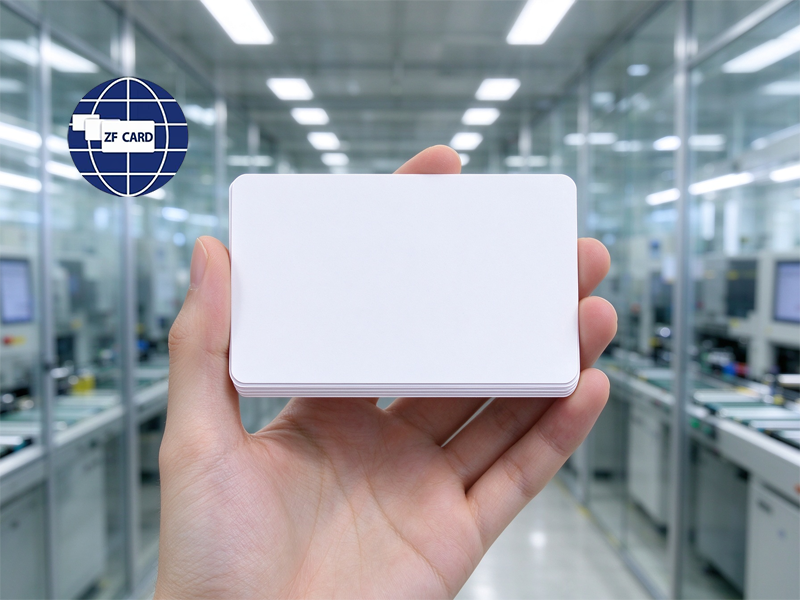
Start with the silicon itself. The Fudan F08 is a 13.56 MHz contactless smart-card chip compliant with ISO/IEC 14443 Type A, with 1 KB of EEPROM organized into 16 sectors of 4 blocks each — the exact same memory map as NXP MIFARE Classic 1K. That pin-to-pin, register-to-register compatibility is the whole reason the F08 took off: a reader firmware written for MIFARE Classic 1K can usually talk to an F08 blank with no changes, and the original 4-byte UID, the sector-key authentication, and the block-read/write commands all behave the same way. Where it differs from the NXP original is price and supply: F08 dies are manufactured in China, ship in large volumes to Chinese card converters, and reach integrators at a meaningful discount, which is why OEMs that used to spec MIFARE by default now write "F08 compatible" into new tenders. It is not a clone in the hacker sense — it is a licensed, documented, second-source IC built to the Classic 1K feature set.
That said, not every card sold as "Fudan F08" on the market is the same part. The gray market is full of so-called F08-compatible dies from smaller fabs, which use the same protocol but vary in write endurance, temperature range, UID uniqueness, and anti-collision behavior. A genuine Fudan Microelectronics F08 chip will guarantee 100,000 write cycles, 10-year data retention, a unique 7-byte or 4-byte UID per chip, and stable performance across the 0–50°C readers that most door controllers live in. A compatible die may read fine on your test bench but fail en masse six months later in a metal-clad elevator reader, or arrive with duplicated UIDs that let one card open two doors — exactly the failure mode access-control projects cannot afford. The buying rule is simple: ask your converter for the chip supplier's COA (certificate of analysis) or die traceability, and insist on a pre-production sample batch that you stress-test on your own readers before approving mass production.
Physically, Fudan F08 cards are almost always delivered as CR80 (85.6 × 54 mm, 0.76 mm) PVC or PETG cards, identical in size to a bank card, because that is the form factor every existing access-control reader was built for. Inside the card, the F08 die is bonded to a thin antenna loop etched into the card core; the bonding quality is what determines read range, which typically lands between 2 cm and 5 cm on a well-tuned reader and card. You can add a magnetic stripe on the back, a scannable barcode or QR code, a signature panel, a UV spot-color logo, hot-stamped foil, or a serial-number laser-engraved along the edge — all standard post-processing steps that a Chinese card converter runs every day. F08 chips also survive lamination, offset printing, and screen printing without derating, which is why they are the default choice when a branded membership card needs to look good as well as open doors.
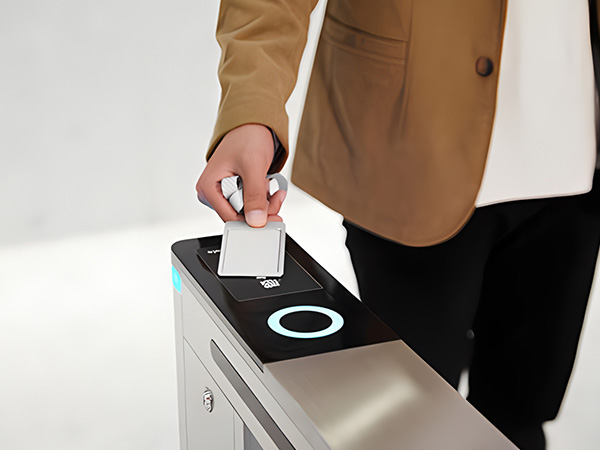
The application list is where Fudan F08 cards punch well above their price point. In access control, they are the workhorse for office buildings, apartment communities, gyms, factory floors, and hotel back-of-house doors. In membership systems, they power gym fobs, coffee-shop loyalty cards, library cards, amusement-park passes, and campus or staff IDs. In vertical applications, F08 cards drive elevator-floor access, parking-barrier entry, laundry or vending micropayments, and time-and-attendance terminals. One important boundary to know: F08 is a memory card, not a CPU card, so it does not replace DESFire or EMV for payment-grade, government-ID, or high-security multi-application projects. It is the right tool when the job is "tap to verify, tap to open, tap to credit," not when it is "tap to move money."
When you write the RFQ, there are five parameters that must be pinned down rather than assumed. First, the UID type: 4-byte (industry standard for access control) or 7-byte random UID, which matters if your reader already has a whitelist loaded. Second, sector configuration: whether the factory delivers blank cards, cards pre-encrypted with a default key (often FFFF or a well-known transport key that integrators must change before deployment), or cards serialized with a per-sector key you supply. Third, whether variable data — a card number, a barcode, a PIN reference — is printed, laser-engraved, or encoded onto the chip itself. Fourth, packaging: individual OPP bags, plain shrink-wrap, or poly-wrapped boxes for warehouse scanning. Fifth, the defect rate, which on a genuine F08 line should sit below 0.3% and should be written into the contract.
Sourcing from a Chinese converter adds a few extra checks worth making. Ask whether the converter stocks Fudan dies locally or orders them on demand, because a die shortage can stretch a two-week lead into six. Ask whether they run a 100% read-and-encode test on every card before packing, not just an AQL sample — on a 50,000-card gym rollout, even a 0.5% miss rate means 250 members showing up at the front desk with dead cards. Ask whether they can ship sample cards to your office, to your reader-integration partner, or directly to the end customer for approval. And ask what happens if a batch arrives out of spec: a serious factory re-runs the failed lot at its own cost and air-freights the replacement.
This is precisely the profile of manufacturer that ZF Card (Zhanfeng) has built over our twenty years as a China-based original smart-card factory. We are not a trading company: our own line inlays, laminates, prints, encodes, and packs Fudan F08 cards under one roof, and we buy Fudan Microelectronics dies in volume directly, which is why system integrators, access-control distributors, and membership-brand owners across more than a hundred countries reorder from us year after year. We supply blank F08 cards, pre-encoded cards, fully printed and serialized membership cards, key-fob and wristband formats built around the same F08 die, and co-branded cards for lock and reader manufacturers. Our line runs 100% read-and-encode testing before packing, holds ISO 9001 quality certification, and keeps both F08 and MIFARE-class dies on the shelf so lead times stay predictable through peak deployment season. We will also match the UID length, the sector-key scheme, the print finish, and the packaging to your existing reader and PMS, rather than forcing you to adapt to our stock.
The fastest way to judge a converter is to tap their cards on your own reader. ZF Card ships free Fudan F08 sample packs to qualified access-control integrators, distributors, and membership-brand buyers worldwide — you cover the courier, and the sample arrives blank, printed, and encoded to your spec, ready to test on your own doors. Send us your reader model, your required UID and sector-key scheme, and your projected monthly volume, and we will reply within one business day with a compatibility confirmation, a firm lead time, and a factory-direct quote.
Stop guessing whether the F08 blank on the quote sheet is genuine silicon or a gray-market die — request your free Fudan card sample today and feel the read-range, the lamination, and the print quality that twenty years of focused card manufacturing actually delivers.


 RFID Tag
 HF RFID Tag
 UHF RFID Tag
 RFID Labels or Sticker
 UHF RFID Labels or Sticker
 RFID Epoxy Tag
 RFID Tag Card
 RFID Ear Tag
 RFID Laundry Tag
 RFID Cable Tie Tag
 RFID Clothes Tag
 RFID Jewelry Tag
 RFID Nail Tag
 RFID Screw Tag
 Ceramic RFID Tag
 Special Tag
 HF ABS Tag
 UHF ABS Tag
 ABS Anti-metal Tag
 HF PCB Anti-metal Tag
 UHF PCB Anti-metal Tag
 UHF PPS Tag
 HF PPS Tag
 Industry Application Tag
 RFID Tags For Asset
 RFID Tags For Apparel
 RFID Tags For Books










 EN
 英语



