A hotel buys ten thousand key fobs, hands them to guests, and discovers in the second week that one in twenty will not open a door unless the guest presses the fob flat against the reader and holds still. No one complains about the price. They complain about the queue at reception. The cause is never visible on the invoice: it is a spec decision made months earlier about chip type, antenna size, housing material, or frequency. These seven specs are what separate an NFC key fob that works for five years from one that fails at the front desk.
The first spec is the frequency, and this is where most projects go wrong before anything else. A 125 kHz proximity fob built around an EM4100 or HID Prox chip is not the same device as a 13.56 MHz NFC key fob, even when the housings look identical. Phones read only 13.56 MHz. A 125 kHz fob that "opens the old door" cannot be tapped by an iPhone, and a 13.56 MHz fob cannot talk to a legacy 125 kHz reader. Confirm the reader's frequency before you confirm the fob.
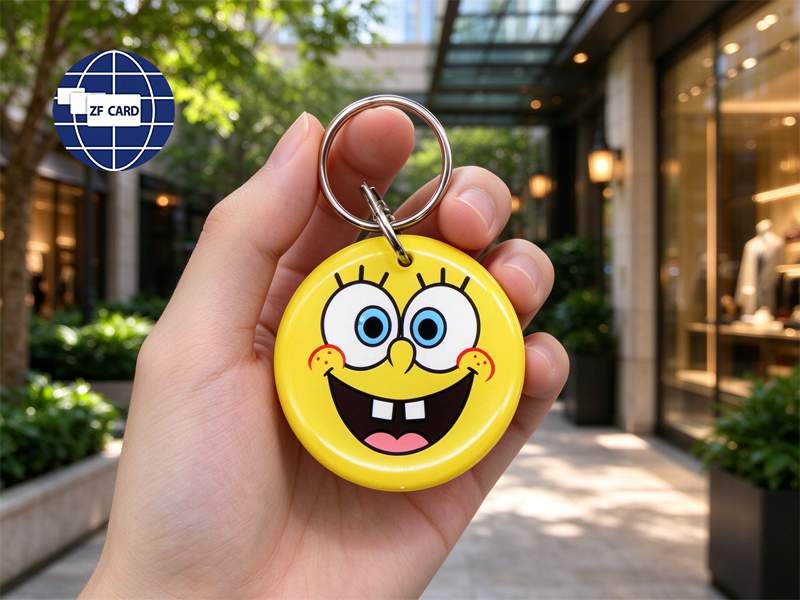
The second spec is the chip. For a hotel lock or a gym locker running MIFARE, Classic 1K is the default and the cheapest, but its cryptography has been broken for years and it should not guard anything valuable. MIFARE DESFire EV3 is the modern answer for secure access, with AES encryption and a proper key hierarchy. NTAG 213, 215, and 216 suit phone-tap applications such as links, check-in, and asset tags. Fudan F08 is a compatible Classic-class option for cost-sensitive projects.
The third spec is the antenna, and it is the spec buyers never ask about. A key fob is a small object, so the loop inside it is small, which caps read distance at roughly two to five centimetres. Shrink the housing for aesthetics and the loop shrinks with it. Move the chip to the edge of the fob and the field weakens on one side. A supplier who cannot explain how the antenna is tuned for your reader is a supplier who has never measured a fob against a real lock.
The fourth spec is the housing and its sealing method. ABS shells joined by ultrasonic welding are the common choice and are fine indoors. For wet environments — pools, spas, laundry, outdoor gates — the fob needs epoxy potting or a sealed PC construction with a tested IP rating, not a marketing claim. Ask for the actual test: immersion depth, duration, and whether the sample was still reading after the soak. Two fobs that look alike can differ entirely inside.
The fifth spec is the mechanical weak point, which is almost always the ring. The metal loop that holds the fob to a keychain is the part that breaks first, because it concentrates stress every time the fob is dropped or yanked. Ask about the ring material, how it is attached, and what pull force the assembly survives. A cheap plated ring that snaps in month three turns a five-year credential into a five-year complaint, and the replacement cost lands on the buyer.
The sixth spec is the personalisation and the print. A fob can be laser-engraved, silk-screened, pad-printed, dual-shot moulded, or filled with a domed epoxy label, and each method behaves differently on a curved surface. Laser engraving is permanent and works on dark housings; pad printing gives colour but wears at the edge; dual-shot moulding puts the colour into the plastic itself. Ask for a physical sample, because artwork that looks clean on a flat proof can drift on a 40 mm oval.
The seventh spec is the encoding and the key handling. A security fob is not just hardware; it carries a UID, sector keys, or an encrypted application. Ask whether the factory writes keys in a controlled room, whether sector keys can be diversified per site, and whether NDEF records for phone-tap fobs are written and locked before delivery. Ask who holds the key file and how it is transferred. If the answer is an email attachment, the access system is already compromised.
Durability deserves its own test plan. A key fob lives in a pocket with coins and keys, gets dropped on tile, sits in a hot car, and is cleaned with alcohol at a hotel desk. Ask for a bend and drop test, an alcohol wipe test on the print, and a UV exposure check on the housing colour. Ask how many units per lot are read-tested, and whether the read test is done after assembly rather than on the bare inlay, because assembly is where most fobs fail.
The application decides the rest. Hotel locks from VingCard, Onity, Salto, and Assa Abloy each expect a specific chip family and card format. Gym and club lockers usually run MIFARE Classic or DESFire. Apartment and office access may be a mix of both. EV chargers and shared equipment often use NTAG for phone taps. Mapping your reader fleet first, then choosing one chip across the estate, is cheaper than stocking three fob types.
Pricing follows those decisions rather than leading them. A fob with a Classic 1K chip, ABS housing, and pad print sits at the bottom of the range; DESFire EV3, epoxy potting, laser engraving, and a hardened ring move it up. Volume tiers, mould or tooling amortisation, encoding complexity, and packaging all shift the number. Ask for a line-item quote that separates chip, housing, print, encoding, and freight, so you can see what each spec actually costs.
The fast way to vet a supplier is to send one RFQ with four questions attached: which frequency and chip, what read distance on which reader, what sealing method and IP rating, and what the ring survives. A factory answers all four with specifics and offers a video of the assembly line. A trader forwards a catalogue. The difference shows up in the sample, not the price list.
This is the work ZF Card (Zhanfeng) has done for twenty years as a China-based original smart-card and fob manufacturer. We produce NFC key fobs in ABS, PC, and epoxy-potted constructions with MIFARE Classic 1K, DESFire EV3, NTAG 21x, and Fudan F08 chips, plus 125 kHz options for legacy readers, for hotel groups, gym chains, property managers, and access-control integrators in more than a hundred countries. Inlay bonding, antenna tuning, housing assembly, laser engraving, encoding, and read testing run in-house.
Every fob order starts with your reader model, because a fob that reads at two centimetres on one lock can fail at four on another. We hold ISO 9001 and ISO 14001 certification, keep RoHS and REACH documentation ready, encode in a badge-controlled room, and read-test every unit after assembly rather than sampling the batch. English-speaking engineers confirm frequency, chip, and housing before quoting, so the sample you approve is the fob you receive. We also hold common chip families in stock, keep your mould, print film, and key file on record for the life of the programme, and ship reorders without waiting on a die allocation.
Nothing about a key fob can be judged from a photo, which is why ZF Card ships free NFC key fob sample packs to hotel groups, gym operators, property managers, and integrators worldwide — you cover the courier, and we send engraved and encoded fobs matched to your reader and chip spec.
Tell us your reader or lock model, chip preference, housing and print requirement, and projected annual volume, and we will reply within one business day with a read-distance assessment, a firm lead time, and a factory-direct quote. Test one on your own door before you order ten thousand — request your free NFC key fob sample today.


 RFID Tag
 HF RFID Tag
 UHF RFID Tag
 RFID Labels or Sticker
 UHF RFID Labels or Sticker
 RFID Epoxy Tag
 RFID Tag Card
 RFID Ear Tag
 RFID Laundry Tag
 RFID Cable Tie Tag
 RFID Clothes Tag
 RFID Jewelry Tag
 RFID Nail Tag
 RFID Screw Tag
 Ceramic RFID Tag
 Special Tag
 HF ABS Tag
 UHF ABS Tag
 ABS Anti-metal Tag
 HF PCB Anti-metal Tag
 UHF PCB Anti-metal Tag
 UHF PPS Tag
 HF PPS Tag
 Industry Application Tag
 RFID Tags For Asset
 RFID Tags For Apparel
 RFID Tags For Books






 EN
 英语



