When buyers plan china warranty card designs customized for a new product line, the first questions are usually about the steps, the available crafts, and how small the first order can be. A warranty card looks simple from the outside, but it passes through artwork, proofing, material selection, finishing, variable-data encoding, and packing before it reaches the box. Understanding that sequence helps you brief a supplier clearly, compare quotes fairly, and avoid a proof-stage surprise. This guide walks through the full process, the crafts buyers choose most often, and how MOQ and cost interact.
A custom warranty card is a branded proof of purchase that travels with the product for its whole warranty period. It records the model, serial, purchase date, dealer, and terms, and it often carries a code for registration or verification. Unlike a printed flyer, it must survive a wallet or a drawer, stay legible after years of handling, and match the quality of the product it accompanies. For watches, jewelry, electronics, leather goods, eyewear, and cosmetics, the card is part of the unboxing experience, not an afterthought.
The first stage is requirement confirmation. Before any design work, the supplier needs the product category, the card format and material, the artwork or template idea, whether each card carries a unique serial or code, the annual quantity and any repeat orders, the packaging, and the target delivery date. The more of these are fixed early, the fewer revisions appear later. This stage also confirms which readers or phones will scan the code, because the code size and quiet zone depend on that.
The second stage is the design draft. Most china warranty card designs customized start from an existing layout that the brand adapts, or from a blank grid built around the logo. The artwork should arrive in AI or PDF, with fonts outlined, colors in CMYK, and bleed extended beyond the cut line. The layout keeps the brand and product name dominant, leaves a clean area for the serial or QR code, and sets the warranty text small but readable. A good draft also marks where foil, embossing, or a hologram will sit, so those features do not overlap the code.
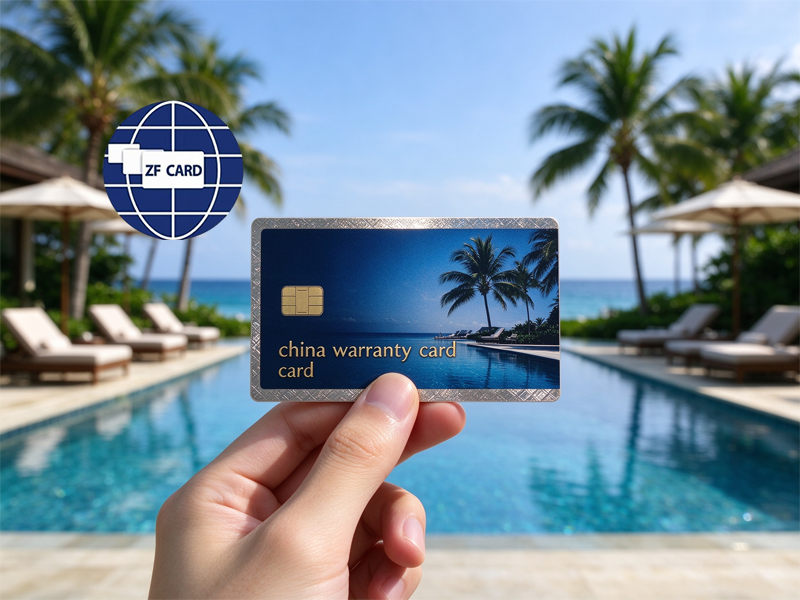
The third stage is proofing, and it has two levels. A digital proof checks layout, color balance, and text against the artwork. A physical proof shows the real thickness, foil shine, surface texture, and code readability on your own phone or scanner. The physical proof should be checked before production: scan the code, bend the card gently, compare the color to the product packaging, and confirm the serial field aligns with the imprint area. Approval on a screen cannot catch registration drift or a weak foil edge.
The crafts begin with the substrate. PVC is the standard rigid, water-resistant choice and holds color well over years. PETG bends without cracking where flexibility matters. Thick PVC or a layered construction reads as premium for jewelry and watch brands. Laminated paper is the lightest option but creases and absorbs moisture. After the substrate, offset or screen printing carries the base artwork; screen printing builds heavier ink coverage for dark or textured backgrounds.
Finishing crafts add the premium layer. Hot foil stamping in gold or silver gives a metallic logo or border. Embossing and debossing raise or press the brand name into the card. Spot UV leaves a glossy shine over a matte face. Domed epoxy coats the card in a raised, polished finish. Matte film resists fingerprints; gloss film makes colors pop. Security crafts include a holographic foil patch, UV invisible ink, and micro-text that is hard to photocopy. Each finish adds a setup step, so the list should match the brand's positioning rather than cover every option.
Variable data is planned alongside the design. If every card carries its own serial number, barcode, or QR code tied to a database, the printer sets up variable-data imposition and checks that no number repeats. The code must be large and clean enough to scan on the first attempt, with enough quiet zone around it. Confirm whether the factory writes the data, exports a matched CSV, or works from your own number list, and whether the code area is locked after encoding so it cannot be rewritten.
For china warranty card designs customized at a low MOQ, the minimum order is driven mainly by setup rather than material. Artwork adjustment, plate or film preparation, and proofing are fixed costs spread across the first run, so a small order carries a higher unit price, while larger and repeat orders bring the price per piece down. Common card formats and stock materials are usually held in stock, which lowers the entry threshold for a brand testing a new line. Ask how the MOQ splits across variants, whether a reorder keeps the existing plates, and whether setup charges apply again on repeat runs.
Production and inspection follow proof approval. The cards are cut, printed, finished, encoded, and checked in sequence. Ask whether every encoded unit is read-tested individually or whether the batch is sampled, and look for a written defect commitment and retained samples from each lot for traceability. Confirm who absorbs cost when a batch arrives misprinted, scratched, or dead, and whether a replacement run and expedited freight are covered. These terms should be written into the order sheet before the deposit.
Packaging and delivery close the process. Cards may go into individual sleeves, folded envelopes, or box inserts, and the order may be grouped by dealer or batch. Ask whether the outer cartons are labeled with the code range or serial block, and how mixed variants are separated inside the carton. Lead time is normally counted from proof approval, and a chip or material shortage can stretch it, so confirm stock status and put the working-day date into the pro forma invoice.
The common mistakes are predictable. A code printed too small or over a dark background will not scan. Artwork sent in RGB shifts color on press. Serial numbers repeat when the data file is not checked against the encoder list. Thin PVC warps in a pocket, and cheap ink fades against sweat or hand cream. Each of these is caught at proof stage if the physical sample is read and tested, not just looked at. Planning a buffer between proof approval and the ship date also protects against a revision round.
This is the end-to-end support ZF Card (Zhanfeng) has provided for twenty years as a China-based original card manufacturer. We have produced china warranty card designs customized for watch, jewelry, electronics, leather, eyewear, and cosmetics brands, alongside member and access cards, in more than a hundred countries. Our in-house line covers PVC and PETG cutting, offset and screen printing, foil stamping, embossing, spot UV, doming, variable serial and QR encoding, and packing, so a card moves from artwork to finished unit without a middle handoff.
We hold ISO 9001 and ISO 14001 certification and keep RoHS and REACH documentation ready for export buyers. English-speaking account engineers review your artwork for CMYK conversion, code size, bleed, and finish placement before quoting, then send a physical proof matched to your design before the press run. Common formats and stock materials are held in stock to support a low minimum order, and the artwork, data file, plates, and print film are retained for repeat orders so a reorder does not pay setup again. Every encoded card is read-tested after assembly, lots are retained for traceability, and our defect commitment and re-run terms are written into the order sheet rather than promised on a call.
The only fair way to judge a custom warranty card is to hold the finished card and scan its code yourself. ZF Card ships free sample packs to brand owners, distributors, and packaging converters worldwide — you cover the courier, and we send printed PVC cards matched to your artwork, finish, and code requirement.
Send your product category, preferred material and crafts, artwork or template idea, code type if any, and projected annual quantity, and we will reply within one business day with a design recommendation, a firm lead time, a low-MOQ option, and a factory-direct quote. Walk your china warranty card designs customized through this process once, and the second order runs itself.


 RFID Tag
 HF RFID Tag
 UHF RFID Tag
 RFID Labels or Sticker
 UHF RFID Labels or Sticker
 RFID Epoxy Tag
 RFID Tag Card
 RFID Ear Tag
 RFID Laundry Tag
 RFID Cable Tie Tag
 RFID Clothes Tag
 RFID Jewelry Tag
 RFID Nail Tag
 RFID Screw Tag
 Ceramic RFID Tag
 Special Tag
 HF ABS Tag
 UHF ABS Tag
 ABS Anti-metal Tag
 HF PCB Anti-metal Tag
 UHF PCB Anti-metal Tag
 UHF PPS Tag
 HF PPS Tag
 Industry Application Tag
 RFID Tags For Asset
 RFID Tags For Apparel
 RFID Tags For Books










 EN
 英语



