An RFQ for a Classic 1K access card usually comes back with two chip options side by side: a Fudan FM11RF08, also called F08, and an NXP MIFARE Classic 1K S50. Buyers assume one is simply a cheaper copy of the other, and most of the time that is close to true — but not in every system. Both are 13.56 MHz contactless chips built around the Classic 1K command set, and most standard readers accept either. The difference shows up where the system checks original silicon, runs anti-cloning detection, or demands a traceable long-term supply. This guide compares the two on compatibility, actual differences, and how to choose before you place a bulk order.
The clearest distinction is the silicon origin. The MIFARE S50 is an original NXP die, manufactured to NXP's design and supplied through NXP or an authorized channel, carrying the manufacturer's marking and an original UID prefix. The Fudan 1K contactless FM11RF08, or F08, is a third-party compatible die built by Fudan Microelectronics to emulate the Classic 1K protocol. It reads and writes like a Classic 1K card, but it is not NXP silicon. That origin is what the rest of the comparison flows from.
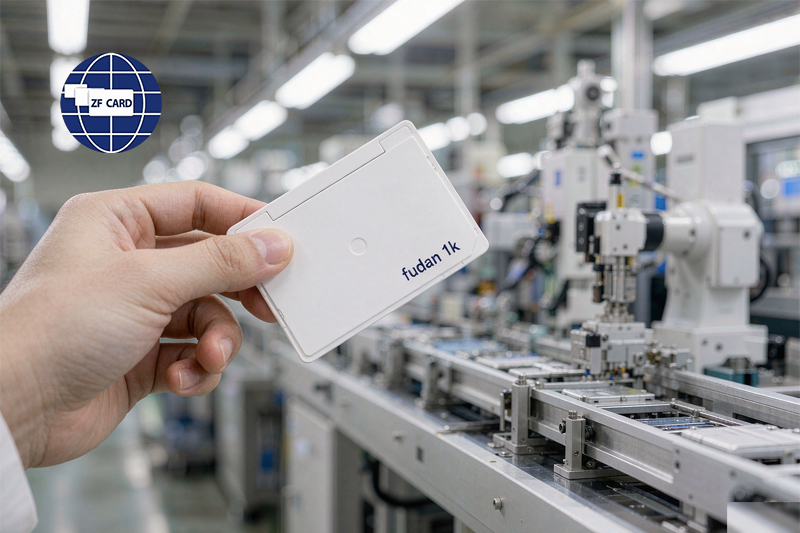
On paper the two match closely. Both follow ISO/IEC 14443A at 13.56 MHz and present the Classic 1K structure: 16 sectors, four blocks of 16 bytes per sector, two read-write data blocks, and a sector trailer holding key A, key B, and access conditions. A fudan 1k contactless card and an S50 card respond to the same Classic commands, hold the same sector layout, and are encoded with the same key logic. For a standard access or membership system, the card behaves the same whether the die is original NXP or Fudan compatible.
Compatibility covers the majority of deployments. A Classic 1K reader installed for ordinary office, apartment, gym, locker, elevator, or parking access generally reads both chips without configuration, because it authenticates with the sector keys rather than verifying the manufacturer. Cards encoded with the same key layout and data structure work on the same doors. If your reader fleet is a standard Classic system and no original-silicon requirement was stated at installation, a compatible F08 is usually a workable lower-cost option.
The differences matter where the system looks beyond the protocol. Original NXP chips carry a manufacturer signature and a UID range that some systems, certified readers, or vendor lock-in schemes check explicitly. A compatible die can fail that check even when the protocol match looks perfect. There can also be small differences in antenna bonding, die yield, and batch-to-batch consistency; a reputable compatible supplier controls these tightly, but an unverified source can ship weak or variable units. The NXP channel offers a documented supply pedigree that a third-party die cannot match.
Readers and firmware add another compatibility layer. Some reader firmware was tuned on original NXP cards and performs slightly better on that silicon, while others handle compatible dies without issue. A reader that reads one chip at four centimetres may read the other at two, or on one side only. This is why a sample tested on your own equipment beats a datasheet comparison: the real reader, the real antenna, and the real housing decide the read, not the chip label alone.
Security level is one point that does not separate them. The Classic line's Crypto1 cipher has been publicly reverse-engineered, and that applies to the Classic protocol both chips emulate. Neither an S50 nor a F08 should be treated as a high-security credential where cloning grants real access; for those programs the answer is a MIFARE DESFire EV3 with AES and diversified keys, regardless of which 1K die you would otherwise choose. Choosing the original over the compatible die does not raise the card above Classic-level risk.
The two options fit different priorities. The Fudan 1K contactless class suits cost-sensitive bulk cards for standard access, attendance, locker, parking, and membership deployments where the system does not require NXP silicon and the threat is low. The original MIFARE S50 suits projects specified around NXP parts, vendor-certified systems, deployments where original-silicon verification runs, or programs that want a documented supply pedigree and consistent long-term sourcing. Match the die to the system requirement rather than to the lowest unit price.
Verify compatibility before volume with a short physical test. Order samples of both dies, read each on your own reader, and check the manufacturer code and UID prefix with a reader tool that reports chip data. Encode a sample with your real sector keys and access conditions and confirm the doors open across the reader fleet. Measure read distance at the actual mounting position and repeat the read several times to catch weak units. If the system documentation states an NXP requirement, confirm it in writing with the reader or system vendor before accepting a compatible alternative.
A practical buying guide starts with four inputs. Confirm the reader model and firmware, whether the system requires original NXP silicon, the sector and key layout your system writes, and your personalisation equipment. Decide whether the threat model justifies the original die or whether compatible parts are acceptable. Then request a sample matched to that reader, test it on your own equipment, and put the die origin, part number, and chip family on the purchase order. Agree on a defect commitment, lot retention, and re-run terms in writing rather than relying on a verbal assurance.
Three mistakes are common. Buyers assume a compatible die is exactly equivalent in every system, which misses signature and firmware checks. Buyers also assume the original S50 is more secure than a F08, when both sit at the same Classic security level. And buyers compare only unit price, leaving out batch consistency, read stability, and who owns a failed batch. Each of these is resolved by the sample test and a clear specification, not by the card artwork.
The decision then narrows to two questions: does the system require original NXP silicon, and how sensitive is the project to cloning? If neither points to original, the Fudan 1K compatible die delivers the Classic 1K function at a lower cost. If the system was certified around NXP, or traceability and stable supply matter more than unit price, the original S50 is the safer call. A side-by-side sample on your own readers settles the remaining uncertainty.
This is the dual-chip supply profile ZF Card (Zhanfeng) has built over twenty years as a China-based original card manufacturer. We supply both original NXP MIFARE S50 and Fudan 1K contactless FM11RF08 F08 dies, mounted in cards, fobs, stickers, and tags for access control, attendance, parking, and membership programs in more than a hundred countries. Our in-house line covers die bonding, antenna attachment, lamination, printing, encoding, and 100% read testing under one roof, and every quotation names the exact chip model and whether the die is original NXP or Fudan compatible.
We hold ISO 9001 and ISO 14001 certification and keep RoHS and REACH documentation ready for export buyers. English-speaking engineers confirm your reader model, firmware, and key layout before quoting, and check whether the system requires original silicon, then send a sample of the matching die for you to test on your own equipment before production. Each encoded unit is tested after assembly, lot samples are retained for traceability, and our defect commitment and re-run terms are written into the order sheet. Common Classic 1K and high-frequency chips are held in stock, with artwork, data file, and tooling kept on record for repeat orders.
The fair way to compare the two dies is to read and encode both on your own reader. ZF Card ships free MIFARE and Fudan card sample packs to access-control integrators, membership brands, and distributors worldwide — you cover the courier, and we send cards of both dies matched to your reader and artwork.
Tell us your reader model, whether you require original NXP or compatible silicon, your sector and key layout, and projected annual volume, and we will reply within one business day with a compatibility note, a firm lead time, and a factory-direct quote. Test a fudan 1k contactless sample and an S50 sample side by side on your own system before you commit to the batch.


 RFID Tag
 HF RFID Tag
 UHF RFID Tag
 RFID Labels or Sticker
 UHF RFID Labels or Sticker
 RFID Epoxy Tag
 RFID Tag Card
 RFID Ear Tag
 RFID Laundry Tag
 RFID Cable Tie Tag
 RFID Clothes Tag
 RFID Jewelry Tag
 RFID Nail Tag
 RFID Screw Tag
 Ceramic RFID Tag
 Special Tag
 HF ABS Tag
 UHF ABS Tag
 ABS Anti-metal Tag
 HF PCB Anti-metal Tag
 UHF PCB Anti-metal Tag
 UHF PPS Tag
 HF PPS Tag
 Industry Application Tag
 RFID Tags For Asset
 RFID Tags For Apparel
 RFID Tags For Books










 EN
 英语



