Every RFID card starts as an inlay: a chip die bonded to an antenna, mounted on a thin substrate, that gets sandwiched between the plastic layers during lamination. The inlay decides whether the card reads, what frequency it speaks, and what the card can do. The TK4100 inlay is one of the most common low-frequency building blocks in the card industry, used wherever a simple, fixed identity needs to be recognized by a 125 kHz reader. This guide explains what it is, how its prelam sheets enter card production, and what to check when sourcing them for bulk card lamination.
The TK4100 is a 125 kHz low-frequency read-only ID chip, broadly compatible with the EM4100 protocol that legacy access systems were built around. It returns a fixed 64-bit identification number when energized by the reader field; it cannot store user data, change its ID, or run encryption. That simplicity is its strength: a low-cost, reliable identity token for systems that only need to recognize a tag, not carry a credential or a wallet balance. It is the chip behind many classic proximity cards, fobs, and tags that have run access control and attendance systems for years.
Frequency is the first thing to get straight. TK4100 and its EM4100-class family operate at 125 kHz, which is a different air interface from 13.56 MHz high-frequency NFC chips such as MIFARE, DESFire, and NTAG. A 125 kHz tag cannot talk to a 13.56 MHz reader, and it cannot be read by a phone's NFC reader, which works only at 13.56 MHz. Before ordering any inlay, confirm the reader's frequency, because a card built on the wrong frequency will not open the door regardless of how well the artwork or the inlay itself performs.
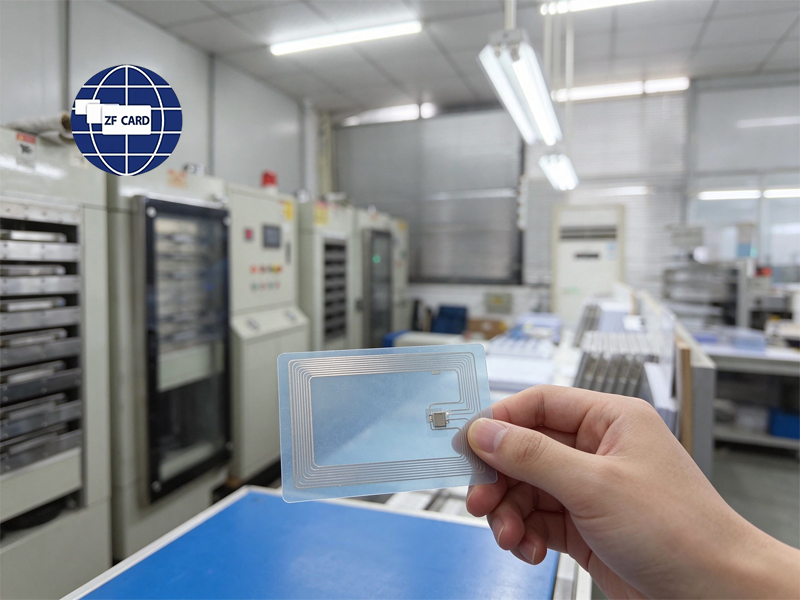
A tk4100 inlay sheet is assembled from three parts: the chip die, the antenna coil, and the carrier substrate. The coil is usually etched or wound on a PET or FR4 film, tuned to resonate at 125 kHz, and the die is bonded to its ends and sealed. In prelam form, the inlay arrives as a flat sheet or roll sized to the card layout, ready to be placed between PVC, PETG, or PC layers before pressing. Some prelam sheets carry an adhesive layer for assembly; others are placed dry during the stack-up. The substrate and its thickness affect how the sheet survives the lamination cycle.
The operating cycle is passive, with no battery. When the reader emits its 125 kHz field, the inlay harvests energy from that field, wakes the die, and transmits its fixed ID back to the reader. Because the chip is read-only, the number assigned at manufacture stays with the inlay for life. There is no on-board memory to write to, no sector key to manage, and no application data to protect. That keeps the inlay inexpensive and dependable, but it also means TK4100 is the wrong base for any project needing encryption, rewritable data, or a mobile wallet credential.
Read range is set mainly by the antenna and the reader, not the chip alone. A properly tuned coil at the inlay's size and geometry reads at roughly two to ten centimeters on a matching 125 kHz reader, though real distance depends on reader output power, antenna size in the reader, housing material, and nearby metal. A coil that is too small, off-center, or tuned loosely will read weakly on one side or at a short reach. Metal structures, conductive ink, and magnetic stripes placed near the loop can weaken the field, so the inlay position in the card layout matters as much as the chip.
The TK4100 class shows up wherever a low-cost fixed ID is enough. Office and apartment access cards, attendance and time clocks, parking and barrier tickets, elevator floor access, patrol and inspection tags, animal identification tags, and key fobs all commonly run on 125 kHz proximity chips. These systems recognize "this is an authorized tag" without needing to store personal data or open a mobile tap. Where the reader fleet is legacy 125 kHz, the inlay has to match that standard even if newer high-frequency options exist elsewhere.
Choosing between a tk4100 inlay and a high-frequency chip comes down to what the system must do. Pick the 125 kHz TK4100 class for legacy proximity readers, low-cost bulk ID cards, and tags that only present a fixed number. Move to 13.56 MHz MIFARE, DESFire, or NTAG when you need encryption, rewritable or diversified data, anti-cloning features, phone tap recognition, or a multi-application credential. Mixing the two in one estate is possible only if the readers support both; a single door usually speaks one frequency.
Sourcing an inlay sheet means locking a short spec rather than a vague product name. Record the chip model and its EM4100 compatibility, the coil size and number of turns, the substrate material and thickness, the sheet or roll dimensions, whether it ships sheet or roll, the adhesive option, and the quantity per batch. Ask how inlays are tested before shipment: each die read for a working ID, and the ID list checked for duplicates. Consistency across the lot matters more than a single perfect sample.
Lamination compatibility is a technical check the card factory controls. The inlay substrate and bond must survive the temperature and pressure of the card press without delaminating, shifting, or losing read range. A prelam sheet that holds its alignment through lamination produces a flat card with a stable read; one that curls or separates under heat shows up as a weak or dead card after pressing. Confirm the inlay is rated for the card material and press cycle you use, whether PVC, PETG, or polycarbonate.
The recurring faults are predictable. The most common is a frequency mismatch: a 125 kHz inlay sold into a 13.56 MHz system, or the reverse. Then there is read-range loss from a poorly tuned coil or metal near the loop, duplicate or non-working IDs from weak incoming testing, and off-spec compatible dies that read on some readers but not others. Artwork that covers the antenna with conductive ink, or a magnetic stripe laid over the coil, also cuts the field. Each fault is caught at the inlay test stage if testing is done per unit rather than by sample.
Before committing a bulk inlay order, run a short validation. Read the sample inlays on your own reader, check the ID numbers for uniqueness, measure read distance at the real mounting position, and run a few through a trial lamination to confirm the sheet survives the press. Retain a sample from the production lot for later traceability, and agree in writing on the defect acceptance and replacement terms. A datasheet and a laminated card behave differently, so the trial run is the last check before volume.
This is the inlay production profile ZF Card (Zhanfeng) has built over twenty years as a China-based original card manufacturer. We supply tk4100 inlay prelam sheets alongside finished PVC, PETG, and polycarbonate cards, fobs, and tags, for access control, attendance, parking, and membership programs in more than a hundred countries. Our in-house line covers die bonding, coil attachment, substrate mounting, prelam sheet cutting, card lamination, printing, encoding, and 100% read testing under one roof, so the inlay and the finished card are tuned together rather than bought from two separate suppliers.
We hold ISO 9001 and ISO 14001 certification and keep RoHS and REACH documentation ready for export buyers. English-speaking engineers confirm your reader frequency and model before quoting, then send sample inlays for you to read on your own equipment before a bulk run. Each die is tested for a working ID and checked against the duplicate-ID list before packing, and lot samples are retained for traceability. Common 125 kHz and 13.56 MHz inlays are held in stock to protect lead time, with artwork, data file, and tooling kept on record for repeat orders. We also prepare inlay layouts matched to the card's antenna position and test read range against your reader before the prelam sheets ship.
The fair way to judge an inlay is to read it on your own reader and laminate a trial card with it. ZF Card ships free inlay and finished-card sample packs to card manufacturers, access-control integrators, and distributors worldwide — you cover the courier, and we send prelam sheets and sample cards matched to your frequency, reader, and card material. Tell us your reader model and frequency, chip preference, card format and material, and projected annual volume, and we will reply within one business day with a compatibility note, a firm lead time, and a factory-direct quote. Confirm the inlay works on your door before you order the batch — request your free tk4100 inlay sample today.


 RFID Tag
 HF RFID Tag
 UHF RFID Tag
 RFID Labels or Sticker
 UHF RFID Labels or Sticker
 RFID Epoxy Tag
 RFID Tag Card
 RFID Ear Tag
 RFID Laundry Tag
 RFID Cable Tie Tag
 RFID Clothes Tag
 RFID Jewelry Tag
 RFID Nail Tag
 RFID Screw Tag
 Ceramic RFID Tag
 Special Tag
 HF ABS Tag
 UHF ABS Tag
 ABS Anti-metal Tag
 HF PCB Anti-metal Tag
 UHF PCB Anti-metal Tag
 UHF PPS Tag
 HF PPS Tag
 Industry Application Tag
 RFID Tags For Asset
 RFID Tags For Apparel
 RFID Tags For Books










 EN
 英语



