Mifare Classic stickers are the quiet workhorse of business identification. A 30 mm round adhesive label holding an NXP MIFARE Classic 1K chip and antenna, printed with your logo and a serial number, sounds small. Pasted across laptops, tool cases, file cabinets, meeting-room doors, and visitor badges, it becomes the cheapest, fastest way to give every asset, door, and person a digital identity that your existing readers already understand. Here is how custom printed Mifare Classic stickers pay back across a real business.
The most direct benefit is asset identification. Instead of logging equipment on a spreadsheet and hoping it is still on site, you affix a Mifare Classic sticker to each laptop, monitor, printer, vehicle, and rolling tool chest. A fixed reader or a handheld NFC phone reads the sticker in under a second, confirms the asset against your register, and stamps the location and the person holding it. Annual inventory drops from days to hours, lost equipment shows up as an anomaly rather than a surprise audit finding, and responsibility becomes attachable to a physical object rather than a memory.
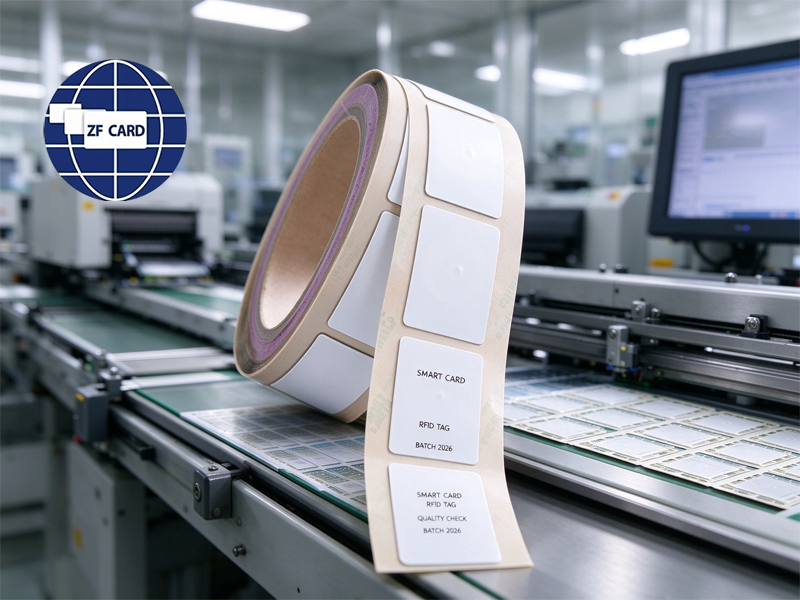
The second benefit is brand presence on something most companies leave generic. A plain white RFID sticker looks like a warehouse item. A custom printed sticker in your brand colors, with your logo, a department identifier, and a scannable QR code linking to an asset-request or loss-report form, looks like part of the company identity. Employees stop peeling them off, visitors notice them, and the same label that opens a door also reinforces the brand on every surface it sits on. For businesses that bill themselves as design-led, that consistency matters.
Custom printing also solves the operator problem. When a sticker carries a human-readable asset number, a barcode, and an NFC chip, every staff member can identify the asset without special training: look at the number, scan the QR code, or tap it with a phone. That redundancy is what makes RFID asset programs actually get used, rather than sitting on a shelf after the pilot. Sticker fields can include owner, department, purchase date, and a line for a signature when the asset is checked out.
Operationally, Mifare Classic stickers compress several workflows into one. Meeting-room booking systems use a sticker on the door as a tap-to-book or tap-to-check-in point. Visitor management uses a temporary sticker on a printed badge that expires at end of day. Time-and-attendance terminals read stickers stuck to employee phone cases instead of issuing separate cards. Library and archive systems tag books and file boxes. Warehouse racks and tooling carts get location labels that tell the inventory system where they are. One chip family, one reader ecosystem, dozens of internal use cases.
Cost is where stickers beat cards. A printed Mifare Classic card is a few dollars; a custom printed sticker is a fraction of that, especially at ten thousand units. There is no lamination bulk, no plastic carrier to dispose of, and no need to issue a new card when an asset leaves the company — the sticker stays with the equipment. For businesses rolling out identification across hundreds of temporary assets, event passes, or a single-floor office, the sticker route is the fastest route to a complete readout.
Because Mifare Classic 1K is the most widely deployed 13.56 MHz protocol in the world, the stickers slot into infrastructure you already own. Existing door readers, parking barriers, elevator controllers, and NFC phones read them without firmware changes. The 1 KB memory split into 16 sectors is enough for an asset record, an access grant, and a loyalty or credit balance on the same label. That continuity is why integrators default to Classic 1K stickers for retrofit projects rather than asking IT to rip and replace the reader stack.
The "custom printed" part deserves a closer look. You can choose round, square, or die-cut shapes from 25 mm to 50 mm, pick a matte or gloss lamination that survives cleaning wipes, and print full-color process art plus variable data — unique serial numbers, barcodes, QR codes, and department tags — on the same press. Adhesive choice matters: permanent acrylic for assets that never leave the building, low-tack removable adhesive for loaner laptops and demo units that must come back clean, and anti-metal ferrite-backed variants for steel cabinets and machine frames where a regular sticker would read weakly. A serious supplier builds all of these into one SKU rather than forcing you to mix catalogs.
The use cases stack up quickly. IT departments tag laptops and monitors with owner and warranty data. Facilities teams tag tooling, carts, and spare parts. Museums and libraries tag books and fragile exhibits. Co-working spaces tag meeting rooms and lockers. Trade shows and conferences use disposable NFC stickers as tap-to-check-in badges. Hotels and serviced apartments tag linen trolleys and housekeeping carts. Each use case is small on its own; together they turn a sheet of adhesive labels into the backbone of a business's physical identity layer.
On the procurement side, pin down five things before ordering. Confirm genuine NXP MIFARE Classic 1K silicon rather than a compatible die, since the latter fails on AES-adjacent authentication and sector-key behavior. Confirm 4-byte or 7-byte UID matches your existing whitelist. Ask for anti-metal variants if your assets are steel. Ask for a printed and encoded sample you can tap on your own reader before mass production. And ask whether the factory can deliver the serial CSV so your asset register imports cleanly. A converter that cannot answer all five is not worth the discount.
This is the sticker production line ZF Card (Zhanfeng) has run for twenty years as a China-based original smart-card manufacturer. We produce custom printed Mifare Classic 1K stickers in paper, PET, and anti-metal ferrite-backed formats, with round, square, and die-cut shapes, full-color offset and screen printing, variable serial and QR data, and 100% read-and-encode testing on every label. We buy genuine NXP MIFARE dies through authorized channels and stock Fudan F08 equivalents for projects that need a lower-cost second source. Our in-house line handles adhesive lamination, die-cutting, encoding, and packing under one roof, which is how integrators, IT asset-management firms, and co-working operators in more than a hundred countries reorder from us.
We hold ISO 9001 and ISO 14001 certification, keep RoHS and REACH documentation ready, and tune each sticker's read range against your reader or phone before mass production. English-speaking account engineers own each order from artwork approval through serial-number CSV delivery, with a written lead time and a below-0.3% defect commitment in the contract. Whether you need five hundred door stickers for a startup office or fifty thousand asset labels for a global rollout, we match the adhesive, the chip, and the print finish to your real surfaces rather than selling you a stock blank.
The fastest way to judge a sticker supplier is to stick their labels on your own assets and tap them. ZF Card ships free custom printed Mifare Classic sticker sample packs to IT asset teams, system integrators, co-working operators, and brand buyers worldwide — you cover the courier, and we send paper, PET, and anti-metal variants printed with your artwork and encoded to your UID scheme.
Tell us your reader model, the surfaces you need to tag, your required UID and sector-key setup, and your projected annual volume, and we will reply within one business day with a compatibility note, a firm lead time, and a factory-direct quote. Stop using spreadsheets to track equipment that already has a chip on it — request your free Mifare Classic sticker sample today and see the print, the adhesive, and the read that twenty years of specialized card manufacturing delivers.


 RFID Tag
 HF RFID Tag
 UHF RFID Tag
 RFID Labels or Sticker
 UHF RFID Labels or Sticker
 RFID Epoxy Tag
 RFID Tag Card
 RFID Ear Tag
 RFID Laundry Tag
 RFID Cable Tie Tag
 RFID Clothes Tag
 RFID Jewelry Tag
 RFID Nail Tag
 RFID Screw Tag
 Ceramic RFID Tag
 Special Tag
 HF ABS Tag
 UHF ABS Tag
 ABS Anti-metal Tag
 HF PCB Anti-metal Tag
 UHF PCB Anti-metal Tag
 UHF PPS Tag
 HF PPS Tag
 Industry Application Tag
 RFID Tags For Asset
 RFID Tags For Apparel
 RFID Tags For Books











 EN
 英语



