A MIFARE sticker is an adhesive RFID tag built around a NXP-family MIFARE die, a flat alternative to a rigid card that carries identity or inventory data. The same format appears in two very different projects: access control, where the tag authenticates a person or device at a reader, and asset tracking, where tags identify equipment, stock, or documents. Choosing the right tag starts by separating these two uses, because the chip, security level, size, and surface requirements differ. This guide covers the specs to compare, the MOQ and sampling questions to ask, and how to source a reliable supplier.
First, define what the tag does in the system. An access control credential proves an authorised person or device may enter, so it must authenticate against sector keys, survive repeated taps, and hold its data for the card's life. An asset tracking tag mostly stores a fixed identity number that a reader or phone scans for inventory, location, or checkout, and it lives on equipment rather than a person. Access leans on security and read reliability at a door, while tracking leans on low per-tag cost, adhesive durability, and easy scanning across many items.
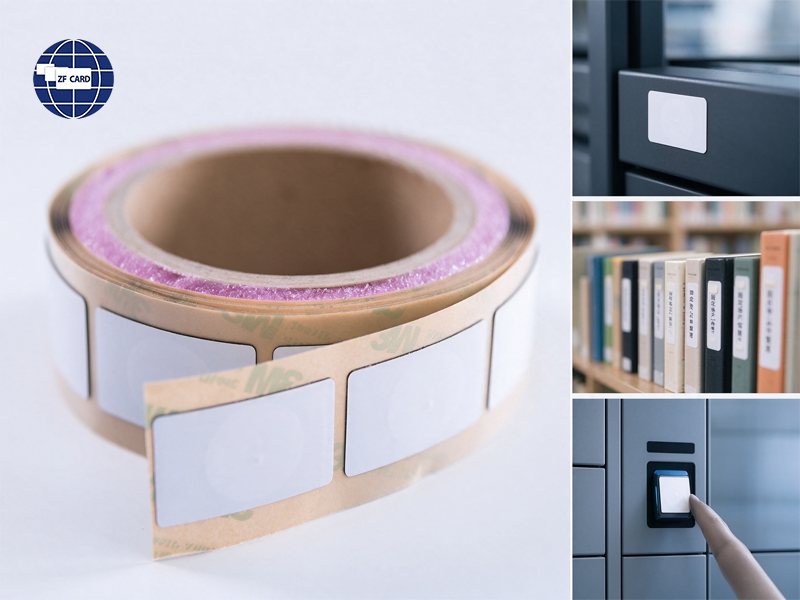
Next confirm the chip family and frequency. MIFARE stickers operate at 13.56 MHz on the ISO 14443A high-frequency standard, the common environment for door readers, membership systems, and NFC phones. Within the family, Classic 1K and 4K offer sector-based memory and key authentication for access and legacy systems; NTAG chips offer simple NDEF storage and phone-friendly NFC interaction for tagging; DESFire chips provide stronger encryption for higher-security deployments. The reader model and existing system decide which family works, so the chip should be matched to the reader rather than chosen from a price list alone.
For access control, security and authentication lead the choice. Door readers verify a sector key before granting entry, so the tag needs the right Classic or DESFire memory, a working key layout, and a die the reader accepts. If the system checks original NXP silicon or runs anti-cloning detection, that narrows the chip choice further. Tags on doors, turnstiles, or shared equipment face repeated handling, so a durable synthetic face and strong adhesive matter more than a thin paper label. Access projects often suit a small standard-sized tag that sits consistently against the reader antenna.
For asset tracking, the priority shifts to identification and scanning efficiency. A tracking MIFARE sticker usually carries a fixed UID or small inventory record that a handheld reader or NFC phone reads to log an item, so a simpler Classic or NTAG die often covers the job at lower cost. Tags may be applied to tools, laptops, files, boxes, or containers, and the label size follows the item's available surface rather than a standard card shape. Durability against dust, light moisture, and peeling matters in warehouse use, but door-grade encryption is usually overkill for plain inventory.
Physical specs cover size, shape, face material, and adhesive. Stickers are cut to squares, rounds, rectangles, or narrow strips, and the face can be paper, synthetic PET or PVC film, matte, or gloss. Paper labels are cheap and fine for short-lived indoor use; synthetic films resist moisture, scuffing, and repeated handling better. The adhesive must suit the surface it sticks to, whether plastic, painted metal, cardboard, or a curved casing. State item material, service life, and any outdoor exposure, so the factory matches label stock rather than a general sticker that lifts or fades.
Antenna design and read distance are tied to the physical spec. A smaller antenna loop gives a smaller label but a shorter read range, while a larger tag reaches a more comfortable tap distance. High-frequency signals are disturbed by metal and damp materials, so a tag stuck onto steel, a metal enclosure, or a liquid container may read weakly or fail; those surfaces call for a ferrite-backed or spacer inlay that keeps the antenna away from the conductive material. Measure the working distance on the actual item and reader before bulk production, since a loose desk demo can differ from the real application.
Compatibility must be checked at the reader level before ordering. Confirm the reader model and firmware support the chosen chip family, and note whether the platform restricts which MIFARE size or die it accepts. A reader configured only for Classic 1K may not authenticate a 4K tag, and some access systems verify original silicon rather than accepting a compatible die. If the existing fleet was built around a known card type, test the sticker on a representative terminal first. Listing the reader models in the inquiry lets the supplier flag any compatibility gap before samples are cut.
Appearance and printing are part of the spec too. A MIFARE sticker can carry a logo, brand colour, serial number, barcode, QR code, or member number on its face, with the antenna hidden behind the label. Variable data such as per-tag serials or QR codes can be printed during personalisation, and numbering can follow the rule your system requires. Keep artwork clear of the antenna area and supply print-ready files so the design stays legible after cutting.
Personalisation and encoding should be agreed before production. Decide whether the factory writes the data or your own bureau and reader station write it after delivery. If the factory encodes, provide the data format, CSV or database mapping, sector keys, and any blocks that must be locked. Each encoded tag should be read back after writing to confirm the data matches the source file. Blank tags can be supplied with die and antenna tested but no personalisation applied. State who encodes, the data layout, and the key requirements in the brief.
MOQ and sampling shape how the order starts. Low minimum order quantities make stickers practical for pilots, short campaigns, and trials that would not justify a full card run. A small first batch tests the inlay on real surfaces, confirms read distance, and checks print quality before a repeat bulk order; repeat orders reuse the recorded inlay, artwork, and coding setup. The exact MOQ depends on chip availability, label size, and printing process, so it should be confirmed in the quote. Standard stock dies and common sizes usually support smaller starts than custom tooling or special shapes.
When sourcing, separate real manufacturers from resellers. A factory controls die bonding, antenna attachment, label cutting, printing, and encoding in-house, can name the exact die and process, and can show production testing and lot traceability. A reseller may offer a wider catalogue but cannot always adjust the inlay or answer compatibility questions directly. Ask about in-house testing, defect handling, export certification, and whether samples are produced on the same line as bulk orders. Sample consistency and clear spec communication matter more than the lowest first price.
A practical selection order keeps function ahead of appearance. Confirm the use case, reader model, and chip family first, then the surface, size, face material, and adhesive, followed by printing, encoding, quantity, and compliance. List which requirements are mandatory and which are optional, and attach any reader manuals, key layouts, or samples from an existing system. If the design or chip choice is not final, start with a sample round rather than a bulk order. Working through these points in order lets a supplier quote an accurate tag, lead time, and MOQ in one pass.
This is the sourcing-support profile ZF Card (Zhanfeng) has built over twenty years as a China-based original smart card and RFID manufacturer. We supply MIFARE stickers, Classic 1K and 4K tags, NTAG and DESFire labels, cards, fobs, and inlays to buyers in more than a hundred countries, with die bonding, antenna attachment, label cutting, printing, encoding, and 100% read testing under one roof. For every sticker order, our engineers confirm your reader model, firmware, sector layout, and attachment surface before quoting, and we name the exact die, antenna size, and face material in the offer.
We hold ISO 9001 and ISO 14001 certification and keep RoHS, REACH, and CE documentation ready for export projects. English-speaking account managers review whether the tags are for doors or asset labels, the surface material, and any nearby metal in your installation, then arrange samples to test against your own reader before production. Each encoded tag is checked after assembly, lot samples are retained for traceability, and defect and re-run terms are written into the order sheet. Common Classic and NFC dies are held in stock, and artwork, data files, and approved samples are kept on record for repeat orders, including low-MOQ first runs. We tune antenna and label size to your reader and surface for pre-bulk sample adjustments.
The safest way to approve a sticker is to test it on your own reader and surface first. ZF Card ships free MIFARE sticker samples to access-control integrators, asset-tracking brands, and distributors worldwide — you cover the courier, and we send tags matched to your reader, artwork, and attachment material. Tell us whether the tags are for access control or asset tracking, your reader model and firmware, the surface they will stick to, the data or sectors you need, label size and finish, and projected annual volume, and we will reply within one business day with a compatibility note, a firm lead time, and a factory-direct quote.


 RFID Tag
 HF RFID Tag
 UHF RFID Tag
 RFID Labels or Sticker
 UHF RFID Labels or Sticker
 RFID Epoxy Tag
 RFID Tag Card
 RFID Ear Tag
 RFID Laundry Tag
 RFID Cable Tie Tag
 RFID Clothes Tag
 RFID Jewelry Tag
 RFID Nail Tag
 RFID Screw Tag
 Ceramic RFID Tag
 Special Tag
 HF ABS Tag
 UHF ABS Tag
 ABS Anti-metal Tag
 HF PCB Anti-metal Tag
 UHF PCB Anti-metal Tag
 UHF PPS Tag
 HF PPS Tag
 Industry Application Tag
 RFID Tags For Asset
 RFID Tags For Apparel
 RFID Tags For Books











 EN
 英语



