Mifare stickers are the adhesive-format workhorse behind a huge share of modern access-control, asset-tracking, and membership deployments. A 30 mm round label holding an NXP MIFARE chip, printed with a logo and a serial number, can be stuck on a laptop, a meeting-room door, a tool cart, or a visitor badge and read by the same readers your business already owns. Sourcing them for a bulk custom project is not the same as ordering a pack of blanks from a consumer store. The difference between a supplier that ships a consistent read on every label and one that ships a bag of mixed-quality stickers shows up only after ten thousand units are on site. Here is how to source quality Mifare stickers for business-scale projects
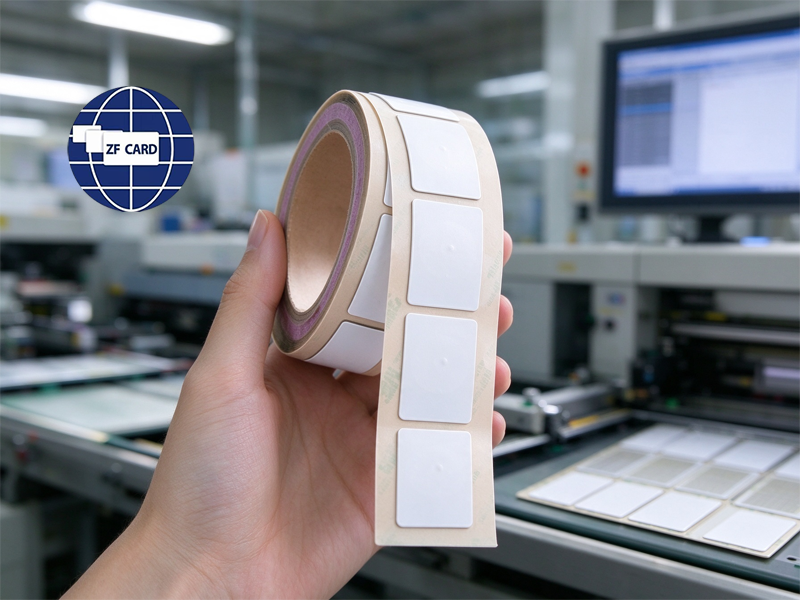
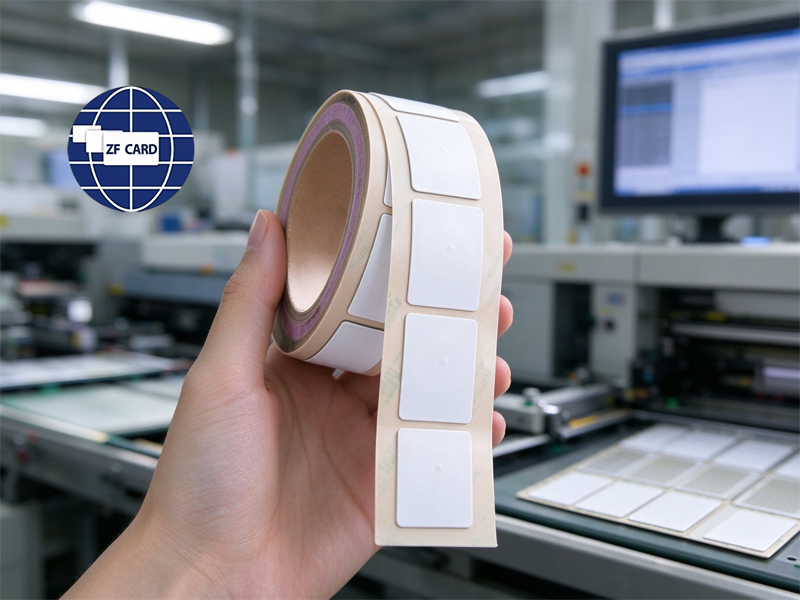
A Mifare sticker is a thin self-adhesive label built around a 13.56 MHz NXP MIFARE chip and antenna loop. It follows the ISO/IEC 14443 Type A air interface, so it talks to the same door readers, parking barriers, elevator controllers, and NFC phones that read standard MIFARE cards. The sticker form factor exists for surfaces where a CR80 card will not fit — asset casings, thin doors, curved equipment, and disposable badges — and it costs a fraction of a rigid card at volume.
The chip family is the first decision. MIFARE Classic 1K is the default for access control, simple membership, and asset tagging: 1 KB of memory, 16 sectors, and the widest reader compatibility in the industry. MIFARE Classic 4K adds more memory for multi-app projects. MIFARE DESFire EV3 steps up to a CPU chip with AES encryption for high-security badges and transit. NTAG 21x variants are the right choice when the reader is a phone rather than a fixed terminal. Pick the chip that matches your reader and your security model, not the cheapest blank on the quote sheet.
The sticker body determines where the label can live. Paper labels are the cheapest and work on flat, dry surfaces. PET or vinyl labels survive cleaning wipes, light rain, and outdoor weather. Anti-metal ferrite-backed labels are mandatory on steel cabinets, laptops, and machine frames, because a bare sticker pasted on metal reads weakly or not at all. Round 25, 30, and 38 mm labels are the most common; square and die-cut shapes fit brand kits. Thickness usually lands between 0.2 mm and 0.5 mm, with thinner labels conforming better to curved surfaces.
Quality in a bulk Mifare sticker project means consistency, not just a good sample. The first metric is read range: every label in the run should read at a similar distance on your reader, not 2 cm on one and 5 cm on the next. The second is UID uniqueness: no two labels in the shipment should share a UID, because that means one card can open two doors. The third is adhesive durability: the glue should hold through temperature swings and cleaning chemicals without peeling or leaving residue. The fourth is print registration: the logo, serial number, and barcode should line up on every label, not drift across the sheet.
Variable data is where business projects diverge from consumer buying. A bulk order usually means every sticker carries a unique serial number, a barcode or QR code, and a sector-key setup matched to your system. The supplier should encode on the same press as printing, deliver a CSV of every serial they produced, and lock the tags after writing so end users cannot overwrite your configuration. Ask whether encoding happens in-house or is outsourced; outsourced encoding adds a week and a handoff point where serial numbers go missing.
When you shortlist suppliers, the first question is chip origin. Ask for genuine NXP MIFARE silicon rather than a compatible die, and ask for the chip part number on the pro forma invoice. Compatible chips look identical on the outside but vary in write endurance, UID uniqueness, and AES authentication behavior — differences that show up six months after deployment. A factory that buys NXP in volume through authorized channels will put the chip brand on the quote without hesitation.
The second question is testing discipline. Ask whether the factory runs 100% read-and-encode testing on every sticker before packing, or relies on AQL sampling. For encoded business projects, 100% testing is the only defensible choice, because a dead sticker in a ten-thousand-unit rollout means a support ticket at a front desk. Ask for a written defect-rate commitment below 0.3% and a re-run clause for out-of-spec batches.
The third question is sample discipline. A quality supplier sends a printed and encoded sample pack before mass production: paper, PET, and anti-metal variants, printed with your artwork, encoded to your UID and sector-key scheme, ready to tap on your own reader. They also ask which reader model you use, because read range depends on the reader antenna as much as the sticker. If a supplier pushes you to approve production from a digital proof only, walk away.
Several failure modes show up only after deployment. A standard sticker on a steel laptop reads weakly — the fix is an anti-metal variant. A sticker on a dusty or textured surface loses adhesion within weeks — the fix is higher-tack acrylic glue and surface prep. A sticker printed on glossy stock is hard to find under bright light — the fix is a printed positioning mark. A supplier that has shipped to real business projects before will flag these in proofing rather than after your launch.
On the commercial side, pin down lead time, MOQ, and freight in writing. A standard printed-and-encoded Mifare sticker should ship in 10–15 working days after proof approval, with rush runs at a surcharge. Ask whether the factory stocks your chosen chip today or needs to air-freight it in, because chip shortages stretch a two-week order into eight. Ask for FOB, DDP, and consolidated freight options so you can match shipping to your deadline. The goal is no surprise charges after the PO.
This is the sticker production line ZF Card (Zhanfeng) has run for twenty years as a China-based original smart-card manufacturer. We produce custom Mifare stickers in paper, PET, and anti-metal ferrite-backed formats, in round, square, and die-cut shapes, around genuine NXP MIFARE Classic 1K, Classic 4K, DESFire EV3, and NTAG 21x chips, with documented Fudan F08 equivalents available for budget projects. Our in-house line runs printing, die-cutting, NDEF and sector encoding, variable serial and URL writing, write-lock sealing, and 100% read-and-encode testing under one roof, which is how system integrators, IT asset teams, and membership brands in more than a hundred countries reorder from us.
We hold ISO 9001 and ISO 14001 certification, keep RoHS and REACH documentation ready, and deliver the encoded CSV with every variable-data run so your asset register imports cleanly. English-speaking account engineers own each order from artwork proof through reorder, with a written lead time and a below-0.3% defect commitment in the contract. We also tune each sticker's read range against your actual reader before mass production, because a tag that cannot be found by your staff is a project that does not ship.
The only fair way to judge a Mifare sticker supplier is to tap their labels on your own reader and stick them on your own assets. ZF Card ships free Mifare sticker sample packs to system integrators, IT asset teams, membership brands, and event organizers worldwide——— you cover the courier, and we send paper, PET, and anti-metal variants printed with your artwork and encoded to your UID and sector-key scheme. Tell us your reader model, your chip preference, the surfaces you need to tag, and your projected annual volume, and we will reply within one business day with a compatibility note, a firm lead time, and a factory-direct quote.
Stop buying blank stickers off a marketplace and encoding them yourself — request your free Mifare sticker sample pack today and see the read range, the adhesive, and the print that twenty years of specialized card manufacturing delivers.


 RFID Tag
 HF RFID Tag
 UHF RFID Tag
 RFID Labels or Sticker
 UHF RFID Labels or Sticker
 RFID Epoxy Tag
 RFID Tag Card
 RFID Ear Tag
 RFID Laundry Tag
 RFID Cable Tie Tag
 RFID Clothes Tag
 RFID Jewelry Tag
 RFID Nail Tag
 RFID Screw Tag
 Ceramic RFID Tag
 Special Tag
 HF ABS Tag
 UHF ABS Tag
 ABS Anti-metal Tag
 HF PCB Anti-metal Tag
 UHF PCB Anti-metal Tag
 UHF PPS Tag
 HF PPS Tag
 Industry Application Tag
 RFID Tags For Asset
 RFID Tags For Apparel
 RFID Tags For Books










 EN
 英语



