A high-security ID project is not buying a card; it is buying a credential that has to be trusted at a gate, a checkpoint, or a back-office door for years. When a faked or altered badge grants real physical access, the substrate choice stops being a preference and becomes a security decision. Polycarbonate cards are the standard substrate for national IDs, police and military credentials, airport and nuclear-site badges, and banking passes, because they resist the attacks a cheap plastic card cannot. This buying guide explains the threats those projects face, why PC cards answer them, and what to lock into the specification and the supplier before production.
Start from the threat list rather than the price list. A security credential can be attacked in four ways: forged from scratch, altered after issue, copied onto another card, or worn into an unreadable state before renewal. Each threat maps to a material behavior. A surface-printed PVC card is exposed to overprinting and peeling; a laminated polycarbonate card buries its image and features inside the body, where they cannot be lifted off. Matching the substrate to these four risks is the first procurement decision, and it narrows the supplier search before any quote arrives.
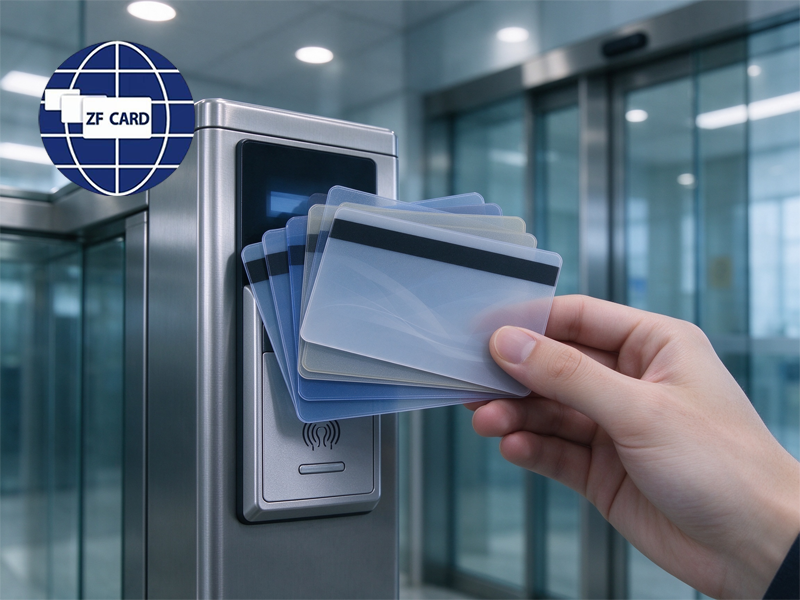
Polycarbonate is a rigid engineering resin originally developed for glazing and impact-resistant panels, and those origins show in card form. It is optically clear, scratch-resistant, dimensionally stable across a wide temperature band, and nearly impossible to delaminate without destroying the card. Where a flexible vinyl card develops a stress line and cracks after repeated bending, a PC card stays flat and legible through a decade of wallet and badge-reel use. That longevity is what lets a government or corporate program amortise the higher unit cost across the full card lifecycle.
Personalisation is where the tamper resistance becomes concrete. On a PC card the holder's photo, name, number, and expiry are burned by a laser into a coloured layer buried inside the laminate, not printed on the surface. Once the laser fires, that image cannot be erased, reprinted, or transferred to another card. Compare that with a thermal-printed PVC badge, where the face can be overwritten or the laminate peeled and replaced. For border control, law enforcement, and restricted-area access, this tamper-evidence is the feature the whole credential rests on.
The security features follow the same buried architecture. Holographic structures, UV-fluorescent inks, guilloche backgrounds, micro-text, and optically variable images sit between the PC layers rather than on top of them. A feature applied to the surface can be scraped or re-laminated; one sealed inside the sandwich has to destroy the card to be removed. Edge-etched serial numbers and digital watermarks add a second layer that survives photocopying. Specifying where each feature sits in the layer stack is part of the design, not an after-print decoration.
Durability covers the daily wear a badge actually meets. Polycarbonate tolerates most solvents, sunscreen, and alcohol disinfectants that cloud or soften vinyl, and it keeps its gloss after repeated wipe-downs. It resists the heat of a vehicle interior and the cold of an outdoor gate without warping. For hospitals, industrial sites, and facilities that sanitize credentials daily, this resistance keeps the card legible and intact through the whole service life, which reduces reissue cost as well as fraud risk.
Chip and interface load is another reason high-security programs choose PC. The substrate supports contact modules, contactless CPU chips, and dual-interface modules sealed in a milled cavity, with enough mechanical stability for a card that carries both a DESFire application and a contact chip. The module sits flush with the body and protected from flex, so the contact interface stays reliable over years of insertion. Ask which modules the factory mills and seals in-house, because an outsourced milling step is where cracked chips and leaking sealant appear.
The specification for polycarbonate cards should lock down more than the material name. Record the layer structure, the personalisation method and laser-compatible layer, the security features and their position in the stack, the chip module and interface, the card gauge and tolerances, the defect acceptance threshold, and the retained-sample policy. Leave any of these open and the supplier fills the gap with the cheapest option on hand. A written spec also makes competing quotes comparable, because every bidder prices the same features rather than a different assumption.
Supplier verification then checks whether the factory can actually run that spec. Confirm it owns a dedicated PC lamination press reaching the temperature and pressure the material requires, rather than a converted PVC line. Confirm chip-module milling and sealing stay in-house. Confirm the encoding area is access-controlled, with logged operators and a written key-handling procedure, and that the factory will sign an NDA before artwork and serial ranges are exchanged. Ask for lot retention and a written defect and re-run clause rather than a verbal assurance on a call.
Physical proofing decides whether the spec works in practice. Before the production run, get a sample you can laser-burn with your own personaliser, because layer sensitivity varies by supplier. Test read distance on your actual readers, bend and drop the card, wipe it with the disinfectant your site uses, and inspect the edge seal and module cavity. A card that looks correct on a proof PDF may fail the burn or the bend. Approval on your own equipment is the gate before tooling and mass production.
Not every credential needs this level of build. National IDs, driver licences, visas, residence permits, military and police credentials, border and airport badges, nuclear and data-centre passes, and banking back-office credentials are clear PC cases. A regular office access card, a gym membership, or a temporary visitor pass usually does not justify the premium, and a PVC or composite card is the rational choice. The common mistakes are buying PC for a low-risk card to look official, or buying PVC for a credential that guards real access, and skipping the personaliser-compatibility check until the cards arrive.
This is the manufacturing profile ZF Card (Zhanfeng) has built over twenty years as a China-based original card manufacturer. We produce polycarbonate cards for government-oriented programs, high-security badge deployments, and banking and industrial clients, alongside PVC cards for access, membership, and hospitality volumes, in more than a hundred countries. Our in-house line covers PC lamination, chip-module milling and sealing, hologram and UV layer insertion, offset and screen pre-printing, laser-ready layer structures, encoding, and 100% read and electrical testing under one roof.
We hold ISO 9001 and ISO 14001 certification and keep RoHS, REACH, and CE documentation ready for export buyers. English-speaking engineers review your personalisation equipment, reader model, and security class before quoting, then send a physical sample for a test burn on your own laser and reader before the press run. Encoding runs in a badge-controlled room, lot samples are retained for traceability, and our defect commitment and re-run terms are written into the order sheet; artwork, data file, and tooling stay on record for repeat orders.
The fair way to judge a high-security PC card is to burn your own data onto it and run it through your own reader. ZF Card ships free polycarbonate card sample packs to government-adjacent issuers, security integrators, and corporate security teams worldwide — you cover the courier, and we send blank and partially pre-laminated cards matched to your chip, laser, and artwork.
Tell us your personalisation equipment model, chip choice, and project security class, and we will reply within one business day with a compatibility note, a firm lead time, and a factory-direct quote. Stop treating a high-security credential like a commodity card order — request your free polycarbonate cards sample today and inspect the lamination, the seal, and the laser burn yourself.


 RFID Tag
 HF RFID Tag
 UHF RFID Tag
 RFID Labels or Sticker
 UHF RFID Labels or Sticker
 RFID Epoxy Tag
 RFID Tag Card
 RFID Ear Tag
 RFID Laundry Tag
 RFID Cable Tie Tag
 RFID Clothes Tag
 RFID Jewelry Tag
 RFID Nail Tag
 RFID Screw Tag
 Ceramic RFID Tag
 Special Tag
 HF ABS Tag
 UHF ABS Tag
 ABS Anti-metal Tag
 HF PCB Anti-metal Tag
 UHF PCB Anti-metal Tag
 UHF PPS Tag
 HF PPS Tag
 Industry Application Tag
 RFID Tags For Asset
 RFID Tags For Apparel
 RFID Tags For Books






 EN
 英语



